Random Number Generator 1 to 4
The random number generator 1 to 4 gives 1, 2, 3 or 4, each with a chance of one in four (25%), the same as a four-sided die. Number your four options, then press Generate.
Updated
Odds for a random number from 1 to 4
Four is a common number of options: four answer choices, four corners of a room, four suits in a deck, four quarters of a pitch, four players around a table. Number the options from 1 to 4 before you draw and let the result decide.
| Question | Answer |
|---|---|
| Chance of a given number in one draw | 1 in 4 (25%) |
| Chance that two draws match | 1 in 4 (25%) |
| Chance that three draws contain a repeat | 62.5% |
| Chance that four draws are all different | 24 in 256 (9.4%) |
| Average number of draws until all four have appeared | 8.3 |
The 8.3 draws in the last row come from the coupon collector's problem: once three numbers have appeared, the fourth still takes four draws on average. Each draw comes from your browser's cryptographic random generator, as explained in how our randomness works.
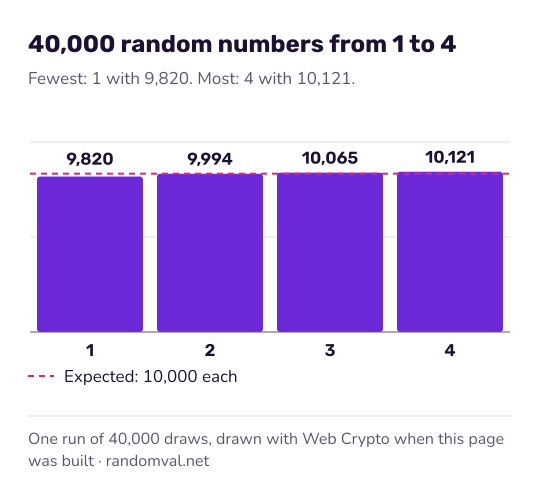
Example: the four corners game with numbers 1 to 4
Students each pick a corner of the classroom, numbered 1 to 4. The teacher presses Generate and gets 3. Everyone standing in corner 3 sits down, the rest choose a corner again, and the draw is repeated until one student is left.
Because every draw is independent, corner 3 can come up twice in a row; that is part of the game. For three corners use the random number generator 1 to 3 instead.
Random Number Generator 1 to 4: FAQ
Is this the same as rolling a D4?
For the result, yes: one whole number from 1 to 4, each equally likely, as with a four-sided die. If you want several four-sided dice added together, use the dice roller.
How do I put four people or four teams in a random order?
Set How many numbers to 4 and tick No repeats. The four numbers come out once each in one of 24 possible orders. To split a list of names into teams first, use the team generator.
Can I use it for multiple-choice answers A to D?
Yes. Read 1 as A, 2 as B, 3 as C and 4 as D. Teachers use this to decide where the correct answer goes when writing a quiz, so the right option is not always in the same place.
Sources
- Wikipedia: Four-sided die — the D4 used in tabletop games (checked October 16, 2026)
- Wikipedia: Coupon collector's problem — the 8.3 draws needed on average to see all four numbers (checked October 16, 2026)