Random Number Generator 1 to 100
The random number generator 1 to 100 draws a whole number from 1 to 100, and each number has a 1% chance. Press Generate, or set How many numbers and tick No repeats to draw raffle tickets.
Updated
Odds for a random number from 1 to 100
A draw from 1 to 100 reads directly as a percentage, which makes it handy well beyond “pick a number”. The chance that the result is N or lower is exactly N percent.
| Result | Chance in one draw |
|---|---|
| One particular number, such as 42 | 1% |
| 10 or lower | 10% |
| 25 or lower | 25% |
| Above 50 | 50% |
| A number ending in 0 | 10% |
| A two-digit number (10 to 99) | 90% |
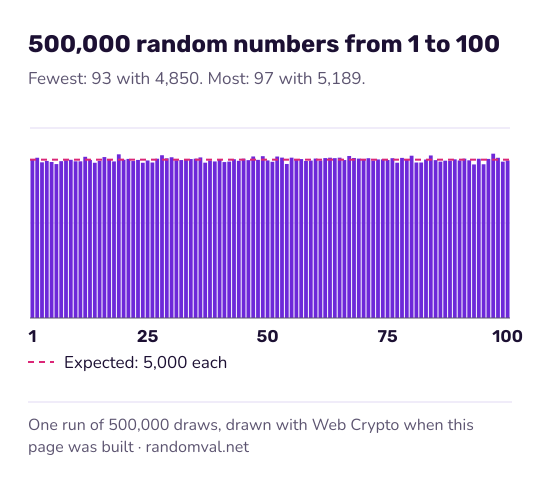
On average it takes about 519 draws before every number from 1 to 100 has appeared at least once, a result known as the coupon collector's problem. A short run will always look patchy. That is normal for random numbers and not a sign of bias.
Each draw comes from your browser's cryptographic random generator, as described in how our randomness works.
How to draw raffle tickets from 1 to 100
A school fair sells tickets numbered 1 to 100 and has three prizes.
- Set How many numbers to 3, one for each prize.
- Tick No repeats, so no ticket can win twice.
- Press Generate. The first number wins the first prize, the second number the second prize, and so on.
The result might be 64, 8, 91: ticket 64 takes the first prize, 8 the second and 91 the third. With repeats left on, the same ticket could be drawn twice, which is rarely what a raffle wants.
If the entries are names rather than ticket numbers, the random winner generator draws from the list directly. For a lottery-style line of numbers, use the lottery number generator.
Random Number Generator 1 to 100: FAQ
Can I draw several numbers from 1 to 100 with no duplicates?
Yes. Set How many numbers to what you need and tick No repeats. This is the setting for raffles with up to 100 numbered tickets.
How likely is a repeat if I leave repeats on?
More likely than it feels. With 10 draws the chance that at least two match is 37.2%; with 12 draws it is 49.7%, and with 20 draws 87%. It is the birthday problem with 100 numbers in place of 365 days.
Is this the same as a percentile die (d100)?
It gives the same kind of result: a whole number from 1 to 100 with equal chances, written d100 or d% in dice notation. Many tabletop games read “roll under 35” as a 35% chance, which is what a result of 35 or lower means here. To roll several dice at once and see the total, use the dice roller.
How do I simulate something with a 15% chance?
Draw one number and call it a success if it is 15 or lower. Exactly 15 of the 100 equally likely numbers qualify, so the chance is 15%.
Sources
- Wikipedia: Coupon collector's problem — the 519 draws needed on average to see all 100 numbers (checked October 16, 2026)
- Wikipedia: Birthday problem — the chance of a repeat when repeats are allowed (checked October 16, 2026)
- Wikipedia: Dice notation — d100 and percentile dice (checked October 16, 2026)