Dice Roller
This dice roller throws up to 20 dice at once, from four-sided to hundred-sided, and shows each die and the total. It starts on one six-sided die, a number from 1 to 6; choose how many dice and which kind, then press Roll.
Updated
How the dice roller rolls each die
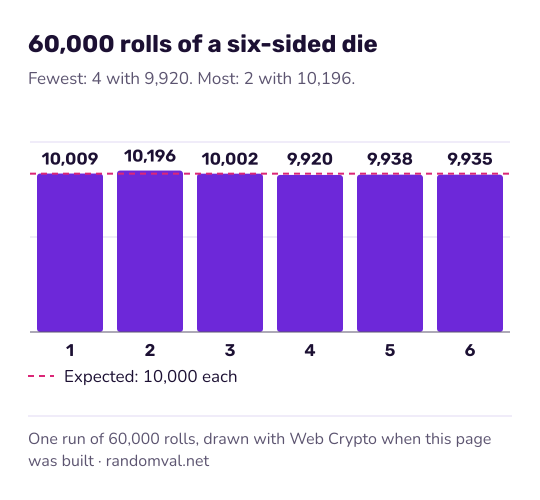
Each die is one unbiased draw of a whole number from 1 to its number of sides, taken from the browser's cryptographic random generator. Every face has the same chance: 1 in 6 on a D6, 1 in 20 on a D20. Dice in the same roll are drawn independently, so they do not influence each other.
The method is the same one the random number generator uses, described in how our randomness works. That makes the roller suitable for board games, role-playing games and classroom probability. It is not a certified device and must not be used for gambling or any game played for money.
Example: rolling three six-sided dice
Set “Number of dice” to 3 and pick D6, then roll. A possible result is 4, 6 and 2: total 12, average 4.00, highest 6, lowest 2.
Three six-sided dice always land between 3 (all ones) and 18 (all sixes). The stats line under the results shows that range next to your actual roll, so you can see where it fell.
What D4, D6, D8, D10, D12, D20 and D100 dice are for
The D6 is the cube used in most board games. The other polyhedral dice, D4, D8, D10, D12 and D20, come from tabletop role-playing games, where the D20 is the main die in games such as Dungeons & Dragons.
The D100 here is a single draw from 1 to 100, used for percentile checks, the same result as the random number generator 1 to 100. For a single four-sided die, the 1 to 4 generator gives the same odds.
Odds of each total with two dice
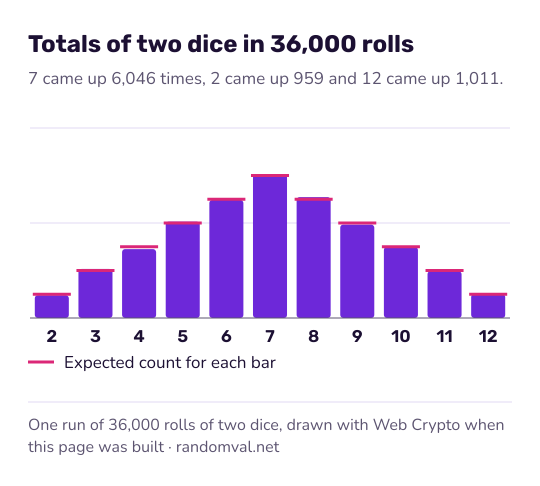
One die is flat: every face is equally likely. Two dice are not, because some totals can be made in more ways than others.
| Total | Ways out of 36 | Chance |
|---|---|---|
| 2 or 12 | 1 each | 2.8% each |
| 3 or 11 | 2 each | 5.6% each |
| 4 or 10 | 3 each | 8.3% each |
| 5 or 9 | 4 each | 11.1% each |
| 6 or 8 | 5 each | 13.9% each |
| 7 | 6 | 16.7% |
What the highlighted dice mean
A die that hits its maximum value is shaded to stand out, and a roll of 1 is shaded differently. Both extremes matter in most tabletop rule systems, as critical hits and fumbles.
Dice roller limits
- Up to 20 dice per roll, all of one type.
- Rolls are not saved: refreshing the page clears them.
- The average shown is the average of your roll, not the long-run average of the die type, which is 3.5 for a D6 and 10.5 for a D20.
For a quick two-way decision, the coin flip is faster than a die.
Dice Roller: FAQ
What are the odds of rolling a 20 on a D20?
1 in 20, or 5%, on every roll. Rolling two D20s and keeping the higher one, as some role-playing games do, raises the chance of at least one 20 to 39 in 400, or 9.75%.
Which total is most likely with two six-sided dice?
7. Six of the 36 equally likely combinations add up to 7, so it comes up one roll in six. 2 and 12 need a double one or a double six and come up one roll in 36 each.
Can I roll different dice in one go, such as a D20 and a D6?
Not in one roll. Each roll uses one die type, so roll the D20 first, then switch to D6 and roll again.
Can I use the dice roller for D&D?
Yes. A role-playing dice set holds a D4, D6, D8, D12 and D20 plus two D10s for percentile rolls, and the roller has every one of them, with the D100 in place of the percentile pair.
For a roll written as 3d6+4, roll three D6 and add 4 to the total yourself, because the roller does not add modifiers. To keep the higher of two D20s, roll two and read Highest in the stats line.
Sources
- Wikipedia: Dice — the standard polyhedral dice and how they are used in games (checked October 16, 2026)