Coin Flip
This coin flip gives heads or tails with a chance of exactly one in two each. Press Flip coin for one toss, or flip up to 1,000 at once and read the counts and streaks.
Sources: Bartoš et al. (2023) Updated
Coin flip history
Coin flip statistics
Heads: 0 (0.0%)
Tails: 0 (0.0%)
Total Flips: 0
Current Streak: None
Longest Streak: None
How the coin flip decides heads or tails
Each flip draws one random whole number, 0 or 1, from the browser's cryptographic generator. A 0 is heads and a 1 is tails, so each side has a chance of exactly one in two.
It is a draw, not a physical simulation of a spinning coin. The coin graphic is an animation that plays alongside and has no effect on the outcome. The same method picks the answer in the yes or no generator, and how our randomness works shows the code.
Example: flipping 100 coins at once
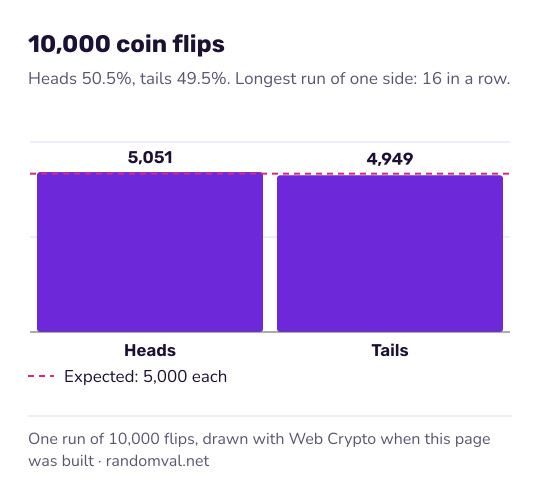
Enter 100 in the “Number of flips” field and press Flip Multiple. A fair coin usually lands somewhere between 40 and 60 heads out of 100, and an exact 50/50 split happens in only about 8% of batches.
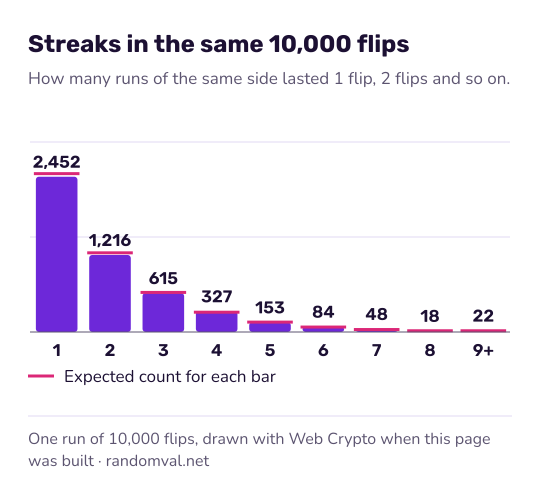
The Longest Streak line tracks the longest run of one side seen so far. In 100 flips a run of five to seven in a row is normal and does not mean the coin is biased; the chart below shows how often streaks of each length turned up in 10,000 flips.
What the coin flip statistics track
The heads and tails counts and percentages add up over your whole visit, single flips and batches together, until you press Reset All Stats. The history shows the 10 most recent single flips, newest first.
Nothing is saved between page loads: refreshing the page starts from zero.
When to flip a coin online
A coin settles a choice between two options: who kicks off, which film, left or right. For three options, the random number generator 1 to 3 works like a three-sided coin, and for more, the random choice generator or the picker wheel.
Teachers use the batch mode for probability lessons: flip 1,000 coins, compare the split with 50/50, then roll the dice roller and compare again.
Coin Flip: FAQ
Is an online coin flip really 50/50?
Yes. Each flip is one unbiased draw of 0 or 1 from your browser's cryptographic generator, so heads and tails each have a chance of exactly one half. Earlier flips have no effect on the next one.
Is a coin flip actually 51/49?
A real coin tossed by hand comes close, with the 51 going to the side that faced up at the start. In a 2023 study of 350,757 flips, Bartoš and colleagues found that coins landed on their starting side 50.8% of the time, near the 51% that Diaconis, Holmes and Montgomery had predicted from a physics model in 2007; heads still came up 50.0% of the time overall. This online coin flip has no starting side, so every result is a new draw at exactly 50/50.
I got heads six times in a row. Is something wrong?
No. Any particular run of six heads has a chance of 1 in 64, and in a long series of flips such runs turn up regularly. Ten thousand fair flips are expected to contain about 20 runs of nine or more of the same side.
Sources
- Wikipedia: Coin flipping — history of the coin toss and research on the bias of real coins (checked October 16, 2026)
- Bartoš et al. (2023): Fair coins tend to land on the same side they started — 350,757 hand flips: 50.8% landed on the starting side, heads and tails 50.0% each (checked October 16, 2026)