Random Team Generator
This random team generator splits a list of names into teams, groups of a set size or pairs; in team mode, sizes never differ by more than one person. Paste your names, choose teams, groups or pairs, and press Make teams.
Sources: Web Crypto API Updated
How the random team generator splits a list
- Read the list. Each non-empty line is one person. Spaces at the ends are trimmed. If you paste a single line with commas, it is split at the commas.
- Shuffle. The whole list is put in random order with the Fisher–Yates shuffle. Starting from the last name, each name swaps places with a randomly chosen name at or before its own position.
- Deal. For teams, the shuffled names are dealt round-robin: the first to team 1, the second to team 2, and so on, starting again at team 1. For groups and pairs, the shuffled list is cut into pieces of the chosen size.
Press Make teams again and the list is shuffled from scratch. Earlier splits have no influence on the next one. The shuffle draws from the browser's cryptographic generator, as described in how our randomness works.
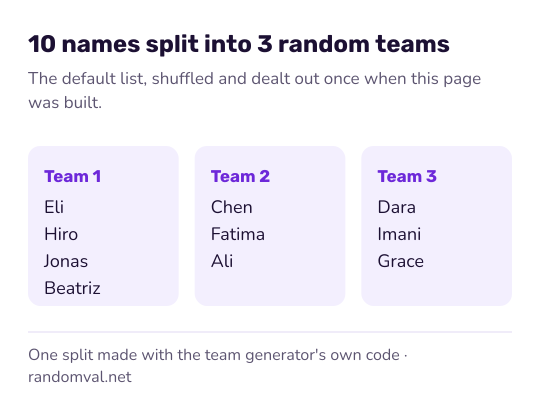
Example: 10 students in 3 teams
Ten students, three teams. After the shuffle the order is: Grace, Ali, Hiro, Dara, Jonas, Chen, Imani, Beatriz, Eli, Fatima.
| Team 1 | Team 2 | Team 3 |
|---|---|---|
| Grace | Ali | Hiro |
| Dara | Jonas | Chen |
| Imani | Beatriz | Eli |
| Fatima |
Ten does not divide by three, so one team has four people and two have three. The extra person always lands in the first teams, but since the order was shuffled first, who that is comes down to chance.
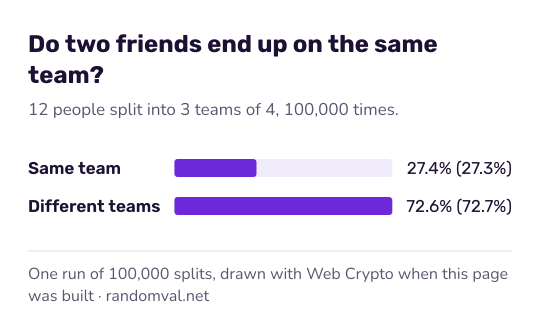
Will two friends end up on the same team?
Only by chance, and the chance is easy to work out. With 12 people in 3 teams of 4, once one friend is placed there are 11 places left and 3 of them are on the same team: a chance of 3 in 11, or 27.3%.
The team generator has no rules to keep people together or apart, so that is the chance every time you press the button. The chart below repeats the split 100,000 times to check it.
Team sizes for 10 to 30 people
“3 × 5” means three teams of five. Pairs use the default setting, where an odd person out joins a pair to make a trio.
| Names | 2 teams | 3 teams | 4 teams | 5 teams | Pairs |
|---|---|---|---|---|---|
| 10 | 5 + 5 | 4, 3, 3 | 3, 3, 2, 2 | 5 × 2 | 5 pairs |
| 15 | 8 + 7 | 3 × 5 | 4, 4, 4, 3 | 5 × 3 | 6 pairs and a trio |
| 20 | 10 + 10 | 7, 7, 6 | 4 × 5 | 5 × 4 | 10 pairs |
| 24 | 12 + 12 | 3 × 8 | 4 × 6 | 5, 5, 5, 5, 4 | 12 pairs |
| 25 | 13 + 12 | 9, 8, 8 | 7, 6, 6, 6 | 5 × 5 | 11 pairs and a trio |
| 30 | 15 + 15 | 3 × 10 | 8, 8, 7, 7 | 5 × 6 | 15 pairs |
Teams, groups or pairs: which split to choose
- Teams when you know how many sides you need: two teams for a football or basketball game, four for a quiz.
- Groups by size when the task sets the size: lab groups of three, discussion tables of four.
- Pairs for two-person teams: partner work, peer review or a secret-partner exchange.
To pick a single person instead, spin the wheel. To put the whole list in a random order without splitting it, use the random order generator, and to give everyone a numbered turn, the number generator with names.
Random Team Generator: FAQ
How are the teams made?
The list is shuffled with the Fisher–Yates method, using your browser's cryptographic random generator, and then dealt out one name at a time like a deck of cards. Every possible arrangement of the list is equally likely, so nobody is more likely to end up in a particular team or with a particular person.
What happens when the names do not divide evenly?
With a set number of teams, the extra people are spread out, so sizes differ by one at most: 23 names in 4 teams gives teams of 6, 6, 6 and 5. With a set group size you choose: add the leftover people to other groups, or let them form a smaller last group. For pairs with an odd number of names, that means one group of three or one person without a partner.
Can I make teams that are balanced by skill?
Not automatically. This tool splits purely at random and does not know anything about the people on the list. A simple workaround is to make the split in two passes: first split your strongest players across the teams, then split everyone else and combine the results.
Can I keep two people apart or together?
No. There are no rules of that kind. Press the button again for a new split, or move a name by hand after copying the result.
Are the names sent anywhere?
No. The split is calculated in your browser. The list is saved in your browser's local storage when you make teams so it is still there next time; the Clear button removes it.
Sources
- MDN: Crypto.getRandomValues() — the random source used for the shuffle (checked October 12, 2026)
- Wikipedia: Fisher–Yates shuffle — the shuffle that makes every arrangement equally likely (checked October 16, 2026)